

When you ask an AI to do something, it has an irresistible urge to complete the task. Not because it’s lazy. But because its entire training paradigm rewards completion. You prompt, it responds, the interaction ends. Ticket closed.
The problem? Quality. The AI might be wrong, the task might not be finished. But the system has every incentive to say “done” and move on. In practice, it causes a lot of low quality work, sometimes unusable or worst, non-working code.
This isn’t a minor bug. It’s the weak point that every major AI company is now racing to fix. And the solution they’re converging on? Stop building smarter single models. Start building teams.
Grok’s Four-Agent Experiment
In February 2026, xAI released Grok 4.20 with something nobody else had shipped at scale: a multi-agent system baked directly into the model.
They gave them names (which I thought was a genius move). Grok (the captain and coordinator), Harper (research and facts), Benjamin (math, code, and logic), and Lucas (creative thinking and blind-spot detection). When you ask Grok 4.20 a complex question, you’re not getting one model’s answer. You’re getting four models debating internally before one of them hands you the response.
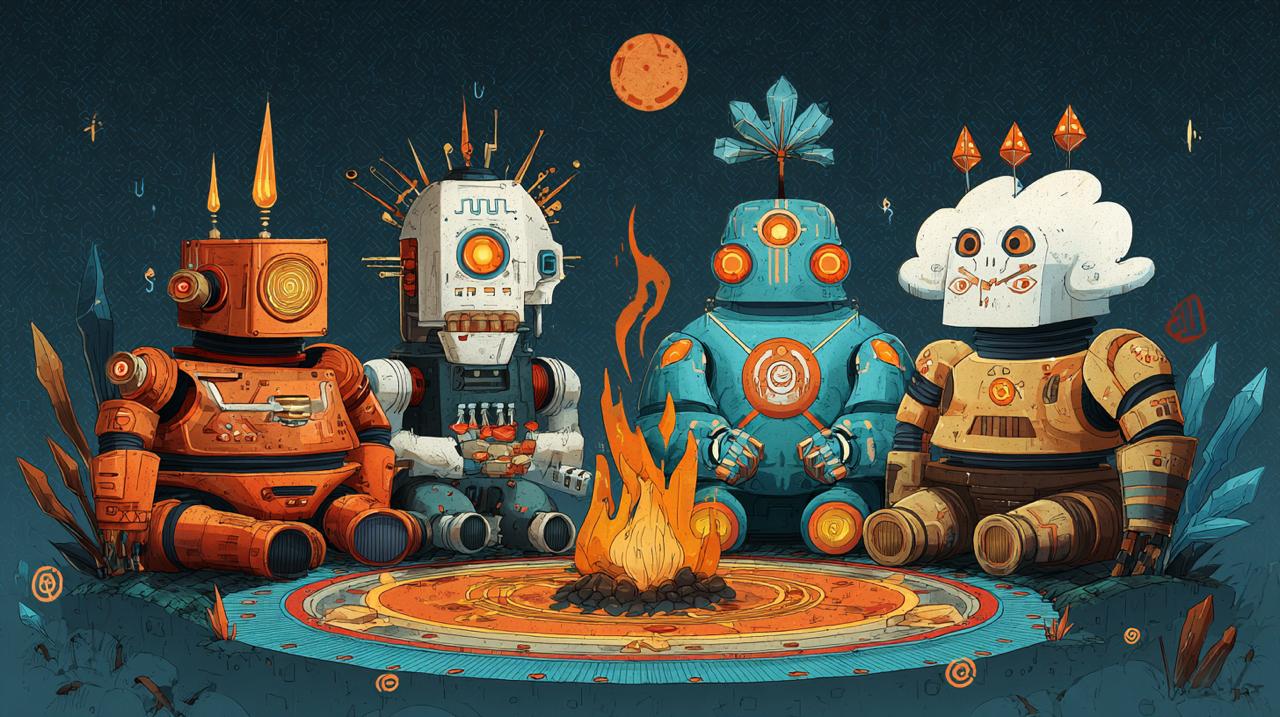
The architecture works like this, according to NextBigFuture’s breakdown:
- Grok decomposes the task into sub-components
- All four agents process in parallel (not sequentially, which matters for latency)
- They debate internally — Harper checks facts against real-time X data, Benjamin stress-tests the logic, Lucas looks for what they’re missing
- Grok synthesizes and delivers one coherent answer
The results? Hallucinations dropped from roughly 12% to 4.2%. That’s a 65% reduction not from a bigger model, but from internal debate.
Why This Matters: The Single-Agent Problem
Let’s back up and review why councils work at all?
The single-agent model has a structural flaw. When Claude generates code, it commits to whatever solution it’s pursuing. It can’t pause mid-generation and ask “wait, does this actually work?” When GPT answers a factual question, it can’t stop to verify its own sources. The process is forward-only.
Developers solved this decades ago. We write tests. We run CI pipelines. We do code review. The code doesn’t ship until someone else checks it.
AI agents have been operating without any of that. They generate, they declare victory, and they move on. It’s like letting a developer push directly to production (you know you’ve done it) with no tests and no review. What could possibly go wrong? Turns out…lots.
I’ve seen this play out in my own work. I ask my agent to back up some files. It says “done!” I check later and nothing happened. It didn’t just think it was finished. It was so overconfident about it, it used to make me doubt myself…am I not seeing something? Did I forget to tell it something?
Or I ask it to fix a bug in my code. It makes a change, declares unbelievable success, it totally, absolutely and undoubtedly fix it, but the bug is still sitting there. It’s jarring.
The issue isn’t intelligence. The issue is structure. Single agents have few incentives to second-guess themselves.
The Architecture: How Grok’s Council Actually Works
Here’s where it gets interesting. Grok 4.20 doesn’t run four separate model calls and stitch them together (that would be expensive and slow). Instead, four specialized replicas of the same underlying model collaborate in real time.
The workflow:
- Task Decomposition (Grok/Captain): The prompt gets analyzed once and broken into sub-tasks. Different pieces route to different specialists.
- Parallel Processing: All four agents receive the full context plus their specialized lens. They generate initial analyses simultaneously, not sequentially. This matters for latency.
- Internal Debate: Here’s the magic. The agents engage in structured rounds of peer review. Harper flags factual claims and grounds them in real-time data. Benjamin checks the math and logic. Lucas spots biases and missing perspectives. They iterate until they reach consensus or flag uncertainties.
- Synthesis: The captain aggregates the strongest elements, resolves remaining conflicts, and produces one coherent answer.
The whole thing runs on xAI’s Colossus cluster (200,000+ GPUs, which is amazing). Because all four agents share model weights and context cache, the marginal cost is closer to 1.5-2.5x a single pass rather than 4x. Clever engineering.
Also worth noting: the full council doesn’t activate for every query. Ask Grok “what’s 2+2” and it bypasses the debate. Ask it to analyze a complex engineering tradeoff and the full team spins up.
Grok Heavy: When Four Agents Aren’t Enough
But wait, there’s more. If you pony up for the SuperGrok Heavy tier ($30/month), you don’t get four agents. You get sixteen.
The Heavy tier is designed for what xAI calls “research-grade problems” — academic research, multi-domain strategy, anything that needs “maximum depth” as AdwaitX describes it. Sixteen agents explore ideas in parallel, running more cross-checks, covering more angles, catching more mistakes.
Is sixteen better than four? For complex research, almost certainly. For everyday queries? Probably overkill. But the tiered approach is smart. You get the four-agent model for free, four agents with the standard premium tier, and sixteen agents when you’re doing serious work.
The architecture scales because it’s still the same underlying model. You’re not running sixteen different models. You’re running sixteen specialized instances that collaborate. The debate just gets more perspectives.
The Competitive Response: Perplexity Goes Wider
xAI wasn’t the only one thinking this way. Perplexity launched “Computer” in late February 2026 with an even more aggressive approach: 19 different models orchestrated together.
The pitch: each task routes to the best-suited model. Need coding? Opus 4.6 handles it. Deep research? Gemini. Speed? Grok. Long-context recall? GPT-5.2.
It’s model-agnostic orchestration. Instead of four specialized versions of one model, you get nineteen different models, each picked for what they’re best at.
Is this better than Grok’s approach? Perplexity’s system gives you the best model for each subtask. Grok’s system gives you coherent collaboration between agents that share context. Different tradeoffs.
What’s clear is that both companies identified the same problem and converged on multi-agent solutions within weeks of each other. When that happens, you’re looking at an industry shift, not a coincidence.
The Developer Tools: Building Your Own Councils
Here’s where it gets practical. You don’t have to wait for Grok or Perplexity to build these systems. The frameworks exist right now.
CrewAI: Role-Based Teams
CrewAI models agents like you’re hiring employees. You give each one a role, a backstory, and a goal. Then you assemble them into a “crew” and assign tasks.
from crewai import Agent, Task, Crew

researcher = Agent(
    role="Senior Researcher",
    goal="Find comprehensive information on any topic",
    backstory="You're an experienced researcher with attention to detail",
    verbose=True
)

writer = Agent(
    role="Content Writer",
    goal="Transform research into engaging content",
    backstory="You're a skilled writer who makes complex topics accessible",
    verbose=True
)

crew = Crew(
    agents=[researcher, writer],
    tasks=[research_task, writing_task],
    process=Process.sequential
)

result = crew.kickoff()
The appeal is obvious. You think in terms of people and roles, not abstract agent graphs. CrewAI also added A2A protocol support for interoperability with other frameworks.
LangGraph: State Machines for Control Freaks
LangGraph takes a different approach. Instead of roles, you model your workflow as a directed graph. Agents are nodes. State flows between them through edges.
This gives you precise control over execution order, branching, error recovery, and human-in-the-loop checkpoints. It’s more complex to set up but better for production systems that need fault tolerance.
LangGraph reached v1.0 in late 2025 and is now the default runtime for all LangChain agents. If you’re already in the LangChain ecosystem, it’s the natural choice.
AutoGen: Conversation Patterns
AutoGen from Microsoft Research pioneered conversation-based multi-agent systems. Agents interact through structured dialogues: two-agent chats, group chats, sequential conversations.
A Group Chat Manager (itself an LLM-powered agent) orchestrates who speaks next. The speaker selection can be round-robin, random, or determined by the LLM based on context.
The downside: Microsoft has shifted strategic focus toward the broader Microsoft Agent Framework. AutoGen gets bug fixes and security patches, but major new features seem unlikely. Still, for conversational patterns, it remains the most mature option.
OpenAgents: The Interoperability Play
OpenAgents is the new player with a different thesis: build persistent agent networks, not one-shot task pipelines.
Agents discover each other’s capabilities, collaborate, and persist across sessions. It’s the only framework with native support for both MCP (Model Context Protocol) and A2A (Agent2Agent Protocol), the emerging standards for agent interoperability.
If you want your CrewAI agents to collaborate with your LangGraph agents through standard protocols, OpenAgents is the bridge.
The Loop Solutions: Verification After Execution
Councils solve one problem: verification before output. But what about verification after the agent actually does something?
Enter the “Ralph Loop” pattern, released by Vercel Labs.
The concept is elegant: wrap an AI agent in a continuous improvement cycle. The agent works, an evaluator checks the result, and if it’s not done, the agent tries again with feedback from the previous attempt.
import { RalphLoopAgent, iterationCountIs } from 'ralph-loop-agent';

const migrationAgent = new RalphLoopAgent({
  model: 'anthropic/claude-opus-4.5',
  instructions: `Migrate the codebase from Jest to Vitest.

    Completion criteria:
    - vitest.config.ts exists
    - No Jest imports remain
    - All tests pass`,

  tools: { readFile, writeFile, execute },
  stopWhen: iterationCountIs(50),

  verifyCompletion: async () => {
    const checks = await Promise.all([
      fileExists('vitest.config.ts'),
      !await fileExists('jest.config.js'),
      noFilesMatch('**/*.test.ts', /from ['\"]@jest/),
    ]);

    return {
      complete: checks.every(Boolean),
      reason: checks.every(Boolean)
        ? 'Migration complete'
        : 'Structural checks failed'
    };
  },
});

const result = await migrationAgent.loop({
  prompt: 'Migrate all Jest tests to Vitest.'
});
The key innovation: the agent literally cannot declare victory until verifyCompletion returns true. No passing the test, no finishing the task.
This is how autonomous agents can run for hours without human intervention. Each iteration checks its own work against defined success criteria. Fail? Try again with the feedback.
The name comes from a Simpsons character (of course). Ralph Wiggum is lovably persistent. The loop keeps going until the job is actually done.
The Protocol Layer: Agents Talking to Agents
One more piece of the puzzle. As these multi-agent systems proliferate, they need to talk to each other. Enter the protocol wars.
MCP (Model Context Protocol), contributed by Anthropic to the Linux Foundation, standardizes how agents connect to tools and data sources. An MCP server can expose any API or database to any MCP-compliant agent.
A2A (Agent2Agent Protocol), launched by Google with 50+ partners, standardizes agent-to-agent communication. Agents can discover each other’s capabilities and collaborate across framework boundaries.
Why does this matter? Because you shouldn’t have to choose a framework and get locked in. Your CrewAI research agent should be able to hand off to your LangGraph coding agent. Your OpenClaw assistant should be able to call your custom MCP tools.
OpenAgents is currently the only framework with native support for both protocols. CrewAI added A2A support. LangGraph and AutoGen rely on community integrations. Expect this to normalize quickly.
The Commerce Layer: Agents That Buy Things
One more infrastructure piece is emerging. What happens when your AI agent needs to actually purchase something?
Stripe’s Agentic Commerce Suite, launched in March 2026, tackles this directly. It gives businesses a way to sell through AI agents without building custom integrations for each one. You connect your product catalog to Stripe, select which AI agents you want to sell through, and Stripe handles discovery, checkout, payments, and fraud detection.
The key innovation is something called Shared Payment Tokens (SPTs). AI agents use these tokens to initiate payments using a buyer’s saved payment method without ever seeing the actual credentials. Each token can be scoped to a specific seller, bounded by time and amount, and monitored throughout its lifecycle.
Why does this matter? Because agents that can research and plan are useful. Agents that can actually execute transactions are transformative. Your research agent finds the best flight. Your booking agent purchases it. Your calendar agent adds it to your schedule. Each one does its job, verifies the work, and hands off to the next.
Stripe isn’t alone in this. Amazon blocked Perplexity’s shopping agent in court, which tells you everything about how high the stakes are. The battle over agent-accessible commerce is just beginning.
What This Means for You
If you’re building with AI, the transformation from single agents to multi-agent architectures changes how you design.
Stop optimizing for single prompts. Think in terms of workflows. Define the roles, the handoffs, the verification steps. Try to figure out when a swarm will perform better than an individual agent.
Build verification into your architecture. Every agent output should be checked by something: another agent, a test suite, a human review loop. The era of trusting AI output because “it sounded confident” is over.
Plan for interoperability. The agents you build today should be able to collaborate with agents built tomorrow. MCP and A2A are your bridge.
Choose frameworks based on your actual constraints.
| If you need… | Use… |
| Fast prototyping with intuitive roles | CrewAI |
| Production durability and state management | LangGraph |
| Conversational multi-party patterns | AutoGen |
| Open protocol interoperability | OpenAgents |
| Continuous verification loops | Ralph Loop |
Where This Is Headed
2025 was the year of the AI employee. 2026 is shaping up to be the year of the AI company.
Tools like Paperclip now let you build org charts for your agents. Budgets per agent. Goal alignment that traces every task to a mission. Full audit trails. You’re not just hiring AI assistants. You’re building AI organizations.
The companies that figure out multi-agent orchestration will ship faster and better. They’ll catch errors before they reach production. They’ll verify work automatically instead of manually reviewing every output.
The companies still using single agents will keep experiencing the same problem. Their AI will say “done” when the work isn’t finished. They’ll wonder why their agents keep closing tickets that aren’t actually resolved. They’ll be the ones still manually debugging AI output at 2am.
The future isn’t one AI doing everything. It’s many AIs, each doing what they’re best at, with someone checking the work.
The good news? The tools to build this are already here. The frameworks are mature. The protocols are emerging. The only question is whether you’ll adopt them before your competitors do.